
Reducing the consumption of natural resources
Decreasing energy consumption.
Decreasing energy consumption.
The Group aims to reach 50% renewable energy in its energy mix by 2030.
To certify the origin of the electricity it consumes, the Group notably relies on the purchase of Guarantees of Origin. This mechanism supports the development of wind, solar and hydropower sectors, while contributing to the reduction of the Group’s carbon footprint.
Developing the second-hand market.
Cdiscount enables its customers to sell their old connected devices to refurbishment professionals through the “Cdiscount Reprise” service. The company has also continued to develop solutions to give returned products from Cdiscount.com a second life. New partnerships have been established with refurbishment experts such as Reficio and Ninety.
Thanks to a wide network of nonprofit and social economy partners, Cdiscount has been giving unsold, broken, or returned products a second life for several years.
Cdiscount is among the market leaders in refurbished and second-hand products, with one in three phones sold on the e-commerce platform being pre-owned. For more information: Cdiscount Reprise
In 2025, Monoprix continued selling refurbished board games in stores through the company Deuzio. Deuzio helps retail professionals structure and implement second-hand toy offerings in-store.
During the holiday season, solidarity toy collection drives were organized in numerous Casino Group stores. This initiative allows customers to donate games and toys they no longer need. Collected toys are repaired, completed, and cleaned at the social integration workshops of the associations Rejoué, Yoti, and the Salvation Army, before being given to families in need or resold at low prices.
Reducing waste
In a context of increasing household vulnerability and the growing impacts of climate change, the Casino Group is more committed than ever to fighting waste.
Teams across the Group—at headquarters, in warehouses, and in stores—work and innovate daily to achieve a shared goal: no edible product wasted.
For more information: Fighting Climate Change
Reducing and recycling packaging
Promoting packaging reuse and bulk products
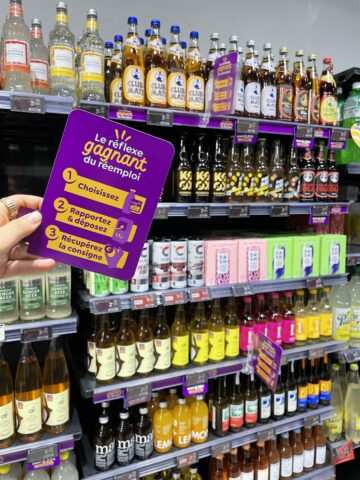
Developing packaging reuse and bulk products in France responds both to legal requirements and to customer expectations, with 92% of French consumers supporting it (Ipsos 2023). Reuse involves using an intentionally designed packaging multiple times to reduce waste and preserve natural resources. The Group is committed at several levels:
Offering products in reusable packaging: Customers pay a deposit when purchasing a product. Once consumed, they return the packaging to the store and recover the deposit. The packaging is then cleaned and refilled by the manufacturer.
Monoprix has partnered with CITEO in the regional ReUse experiment, aiming to establish a reuse loop in four regions of France: Brittany, Pays de la Loire, Normandy, and Hauts-de-France. This regional pilot precedes a national rollout. Officially launched in June 2025, the initiative involves around twenty Monoprix stores. The retailer has also been collaborating with Loop since 2024 in selected stores in the Île-de-France region.
Offering refillable products: Customers keep the original packaging and refill it with dedicated refill products. This approach is mainly developed in household and personal care sections (e.g., laundry detergent, body soap).
The casino Group offers refillable products from national brands and also develops refillable items under its own brands. For example, in 2023, Monoprix became the first retailer to offer a refillable roll-on deodorant.
Expanding the bulk product offering: Bulk sales allow customers to purchase products without packaging and buy only the quantity they need, helping reduce waste. Currently, the bulk assortment mainly includes dried fruits and grocery items. In 2025, Monoprix joined the Défi Vrac Coalition, an initiative led by four manufacturers (Bel, Danone, Famille Michaud, and Lesieur) to expand bulk options to paste-like, viscous, and semi-liquid products, both dry and ambient.
Eco-designing the packaging of our private-label products.
We work every day to offer eco-designed packaging aimed at reducing environmental impact. From the design stage, we minimize the amount of materials used and eliminate any unnecessary components. Our goal is to reduce plastic use to the minimum required while ensuring proper product preservation. Our roadmap includes replacing plastic with renewable and certified materials whenever relevant. To preserve resources, we incorporate recycled materials wherever possible. Finally, we focus on the end-of-life of our packaging, ensuring proper integration into existing recycling streams and improving recyclability.
For every new product development or redesign of an existing private-label product, we collaborate closely with our suppliers using the “5R” method (Refuse, Reduce, Recycle, Reuse, Return to Earth) to identify potential optimization levers: removing a component, reducing packaging weight, improving recyclability, using recycled materials, offering eco-refills, or making packaging compostable.
Sorting and recovering waste
Stores and warehouses sort their waste, mainly paper, cardboard, plastics, and organic waste.
Collection points for used products—such as batteries, light bulbs, and small appliances—are available for customers to recycle.
With the support of Danone, Monoprix offers in selected stores machines that allow customers to return their plastic bottles in exchange for a voucher or to make a donation to an association.